Which of These Five Scope Traps Are Costing You the Next Level?
I've created a free six-page Scope Audit to help you find out which of your current projects are building next-level evidence, which are keeping you busy, and what to get agreed in writing before your next promo cycle.
Ten minutes. Three scores per project.
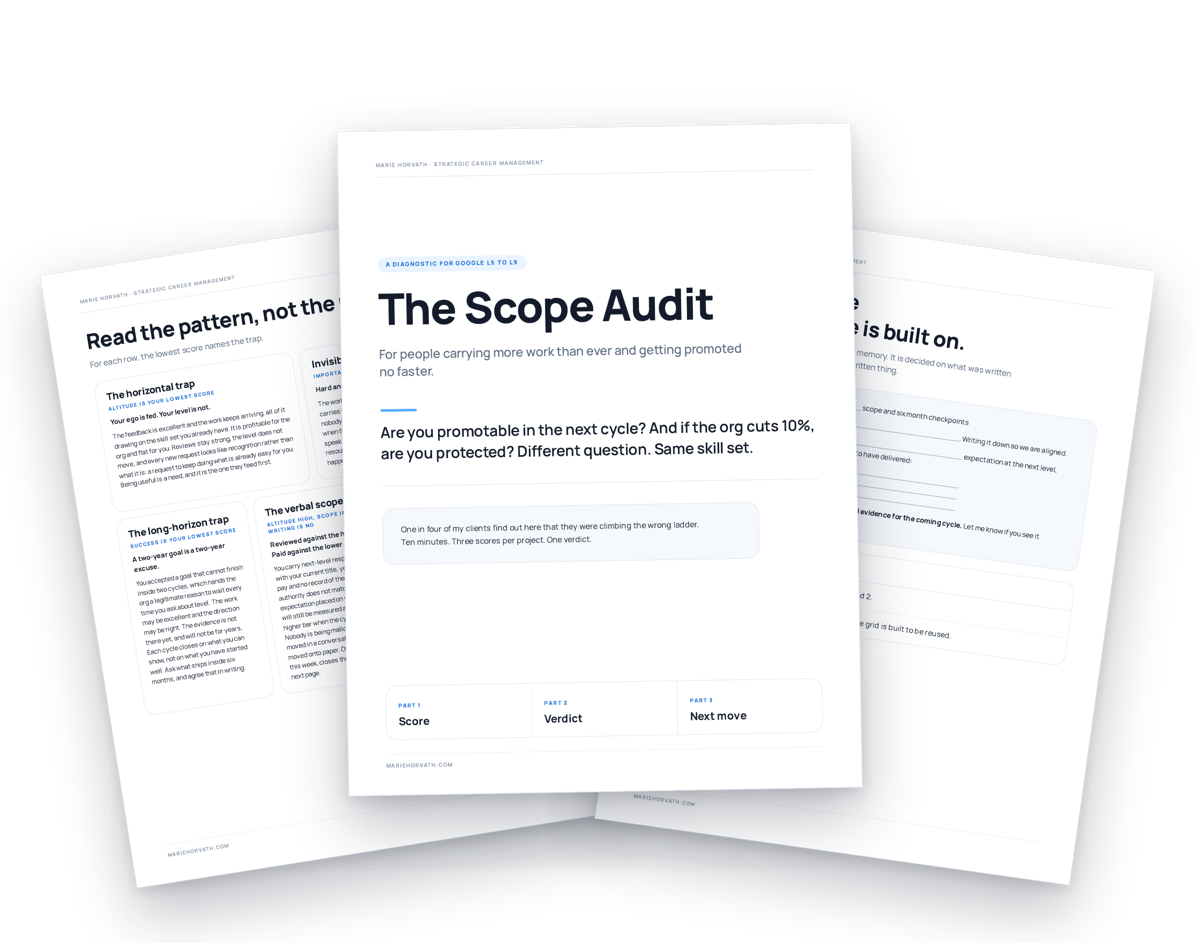
Free six-page PDF. No payment or call required.
You're Doing Great Work. So Why Aren't You Getting Promoted?
You take on more responsibility. You deliver what you promised. Your manager is happy with your work.
Then promotion time comes around, and you hear the same thing again.
"Not this cycle."
Here's what most Googlers don't realize.
You and your manager may have agreed on exactly what you needed to deliver.
But that doesn't mean you agreed on work that would actually help you get promoted.
There are two questions you need to ask yourself:
Because if the answer to either question is no, you can do an amazing job and still have a weak case for promotion.
Think about it.
The promotion committee isn't just looking at how hard you worked or how well you delivered.
They're looking for proof that you're already doing work at the next level, on things that matter to the business.
And if your projects don't show that, working harder on them won't fix the problem.
More Visibility Isn't the Answer. Better Scope Is.
You've probably been told you need more visibility.
Get in front of senior leaders. Speak up in meetings. Make sure people know what you're working on.
But here's the problem with that advice.
If you're not doing next-level work, getting more people to notice it isn't going to help you get promoted.
It just means more people see you doing the same work you've already proven you can do.
The better approach?
Start by choosing projects that are important to the business and require next-level complex problem-solving skills.
When you're responsible for work like that, senior leaders have a reason to pay attention.
They care about the outcome. They want to know how it's progressing. And they have a reason to see what you're capable of.
That's how you build visibility that actually matters.
You don't have to chase attention.
You need to be doing work that's worth paying attention to.
And that's exactly what my free Scope Audit helps you figure out.
Five Traps Hidden in Work You're Already Doing
Your lowest score names the trap. Open the one that sounds like your week.
01The horizontal trap
02Invisible work
03The long-horizon trap
04The verbal scope trap
05The thin-margin trap
Which of Those Traps Is Your Current Work In?
Take one project you own right now and give it the three scores. The dials name the trap that project is sitting in, so you can see which one is holding your level where it is today.
This is one project and three scores. In the document you score every project you own, twice, and the pattern across all of them is what turns into a decision.
How likely is this to produce a finished, defensible result inside the coming cycle?
How far up does anyone actually care whether this succeeds?
Whose job is this kind of work, at your company, today?
Nothing is bad and nothing is strong. You are busy, and no single row carries enough weight to build a case.
The full document scores every project you own, twice, and turns the pattern into a decision.
What a Year at the Same Level Costs
These are the published bands. Pick your ladder, tap the level you are on now, and the chart adds up what one more cycle at that level costs you.
| Level | Total comp | Step up |
|---|---|---|
| L5 Senior | $452K | — |
| L6 Staff | $735K | $283K |
| L7 Senior Staff | $804K | $69K |
| L8 Principal | $1,290K | $486K |
| L9 Distinguished | $2,030K | $740K |
Total compensation, United States, self-reported to levels.fyi and retrieved October 2026. Base, first-year equity and bonus combined. Figures vary by location, role and individual circumstances and are not promised outcomes.
Cumulative difference against the next level, if the promotion does not happen.
I've Watched This Happen Case After Case
I'm an approved supplier to Google, Amazon and HubSpot. Alphabet pays me $5,000 an hour for advisory work and training.
For the last ten years I've coached Googlers through their promo cycles, across five countries and three continents. I've watched case after case of what calibration rewards and what it quietly passes over, and the difference is almost never how hard someone worked.
What This Has Looked Like for Other Googlers
Documented individual client results. Results are not typical or guaranteed.